
Kevin Durant Scoring Efficiency Breakdown
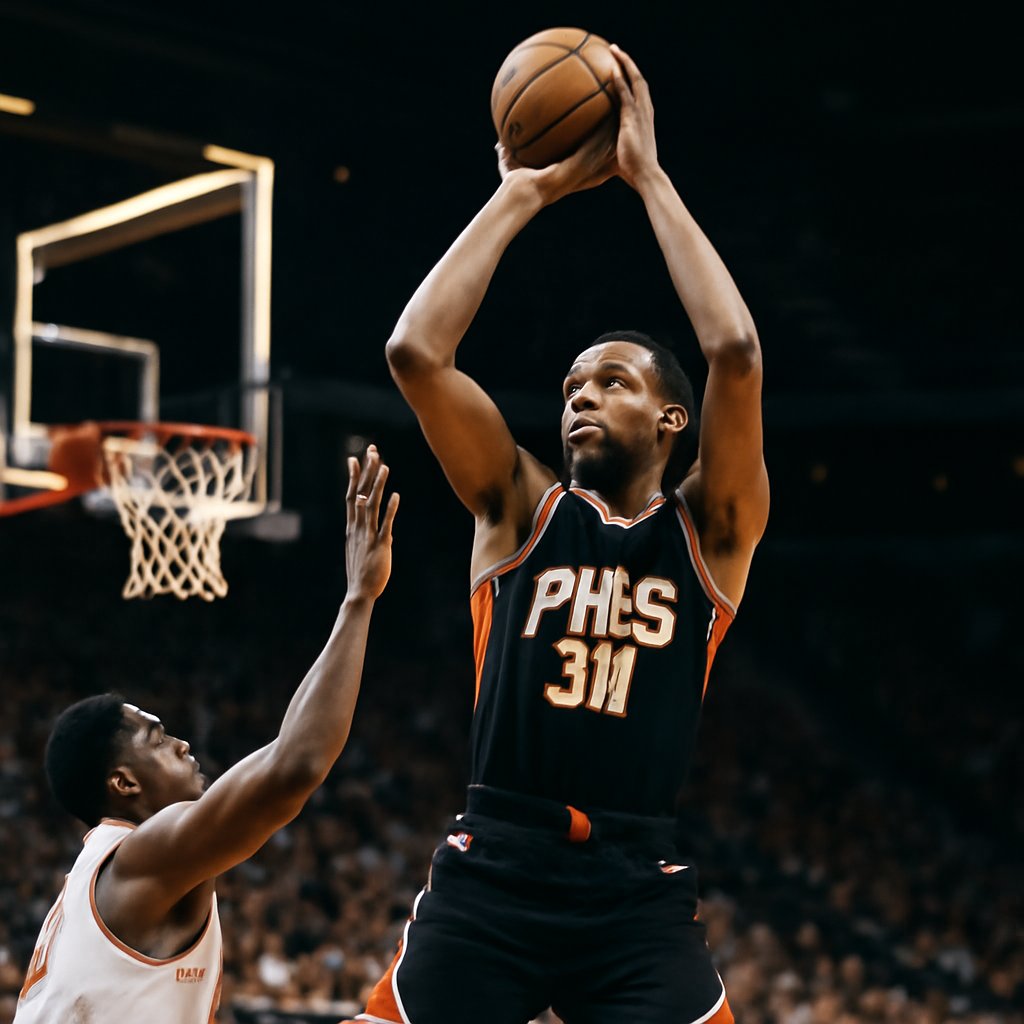
Kevin Durant’s journey on the court has always felt like more than just numbers on a screen. From those early days in Seattle to the bright lights in Phoenix, his ability to score with such grace and precision speaks to something deeper—the way basketball has lifted generations of young Black athletes, teaching them to move with purpose and protect their space in a world that often tries to shrink it.
What gets lost in the highlights is how consistently he’s blended that 7-foot frame with a silky mid-range touch and a growing comfort from deep. Over 15-plus seasons, he’s held a career field goal percentage right around 50 percent on nearly 19 attempts per game, with a true shooting mark of 61.9 percent across more than 1,000 regular-season outings. Those early years in Oklahoma City saw him post a 50.3 percent clip through his first eight seasons, building on an elite pull-up game that only sharpened with time.
The game has always been bigger than stats, and Durant’s peak stretches in 2012-13 and 2013-14 showed what refined craft can do. True shooting percentages of 64.7 and 63.5 percent came from a jumper that punished closeouts and finishes at the rim that felt almost inevitable. Even when sharing the floor in Golden State with Steph Curry and Klay Thompson, he kept shooting 52 percent on 19-plus attempts per game, proving efficiency doesn’t have to fade when the spotlight multiplies.
Breaking down his shot profile tells its own story of versatility. Around 48 percent from 10 to 16 feet, better than 68 percent at the rim thanks to crafty footwork, and a steady 38 to 40 percent from three on measured volume. Relative to the league, his effective field goal percentage has sat in the 58th to 62nd percentile among wings, often clearing 1.25 points per shot attempt in half-court sets. In transition he turns defense into offense with the same quiet authority that defines so many players who learned the game in tight community gyms.
The spacing Durant commands has fundamentally altered how opposing defenses must organize themselves. Because of his shooting range extending well beyond the arc, defenders cannot sag into the paint to help with penetration—a luxury most teams enjoy against traditional big men. This spacing benefit ripples throughout the entire offense, freeing teammates to operate in less congested areas and creating driving lanes for guards. When Durant plays alongside ball-dominant guards, the compounding effect becomes nearly impossible to defend. Teams must choose between respecting his outside shot or risking the fundamental breakdown of their defensive structure.
His footwork deserves particular examination because it represents the bridge between his physical gifts and his scoring efficiency. The step-back jumper, which he’s perfected over two decades, creates separation through technique rather than athleticism alone. This matters increasingly as age naturally diminishes explosiveness. By stepping back while simultaneously shifting his weight, Durant creates space on defenses that think they’ve closed out tight. The move is nearly uncontestable because defenders cannot reach far enough to affect it without fouling, and even reaching does little to alter the shot’s trajectory given his release point sits higher than most wings.
Playoff moments add another layer, where the pressure tests everything. Across 85 postseason games he’s averaged 29.5 points on 48.9 percent shooting from the field and 39 percent from three, with a true shooting mark near 60 percent. The 2017 and 2018 Finals runs featured 52 percent field goal shooting, exploiting every mismatch with length and that signature step-back. Injuries have tested his rhythm too, yet returns like the 2020-21 season in Brooklyn—62 percent true shooting in 35 games—remind us how resilience travels with the great ones.
Understanding pick-and-roll efficiency provides crucial context for Durant’s value in modern offensive systems. His 1.12 points per possession as a ball-handler in these situations ranks in the elite tier league-wide, demonstrating how he creates advantages when tasked with initiating offense. This figure becomes even more impressive considering the volume and the frequency with which opponents dedicate their best defenders to stopping him. Many elite scorers see their efficiency plummet when forced into heavier creation responsibilities, yet Durant maintains his elite scoring while simultaneously generating open looks for teammates.
The three-point revolution changed basketball permanently, and Durant adapted earlier and more successfully than most forwards of his generation. His progression from respectable three-point shooter to legitimate deep threat mirrors the league’s evolution itself. In his first seasons, Durant attempted around three three-pointers per game. By his final years with the Thunder, that number climbed to five. In Golden State and beyond, he’s often operated as a primary three-point threat, sometimes taking six or more attempts per night. Maintaining 38-40 percent efficiency on this volume, especially in playoff basketball where defensive intensity spikes, separates him from peers who’ve attempted similar volume expansions.
Key markers along the way include a mid-range conversion rate of 47.8 percent that ranks among the best for high-volume scorers since 2010, 39.1 percent from three in the playoffs on 5.8 attempts per game, 1.12 points per possession as a pick-and-roll ball-handler, and clutch effective field goal percentage of 54.3 percent in the final five minutes when the score is within five. His season-best true shooting mark hit 65.2 percent back in 2013-14.
The psychological dimension of Durant’s efficiency extends beyond the measurable statistics. Opponents approaching him for defensive assignments must process the reality that nearly every option remains available to him. Does he shoot the three? Does he attack the mid-range? Will he post up? Can he beat you off the dribble? This uncertainty creates hesitation, and hesitation against a player of Durant’s skill level translates directly into scoring opportunities. Elite scorers weaponize their unpredictability, and few have mastered this art quite like Durant.
Comparing efficiency metrics across different eras requires caution, yet Durant’s standards hold up against any generation of forward. His 61.9 career true shooting percentage exceeded that of LeBron James (59.5), Larry Bird (58.8), and even matched or exceeded many guards who typically post higher efficiency numbers. This achievement carries weight because it occurred across multiple teams, multiple eras of rule changes, and multiple offensive philosophies. Consistency across context often separates the truly elite from those whose excellence depends on specific circumstances.
Much like the WNBA players who carve out space with footwork and vision rather than raw power, Durant’s efficiency reminds us that basketball’s real beauty lives in the details—the anticipation, the angles, the way a single player can shift an entire community’s sense of what’s possible. His body of work stands as both a personal triumph and a quiet blueprint for the next wave of scoring wings coming up in gyms from coast to coast.